
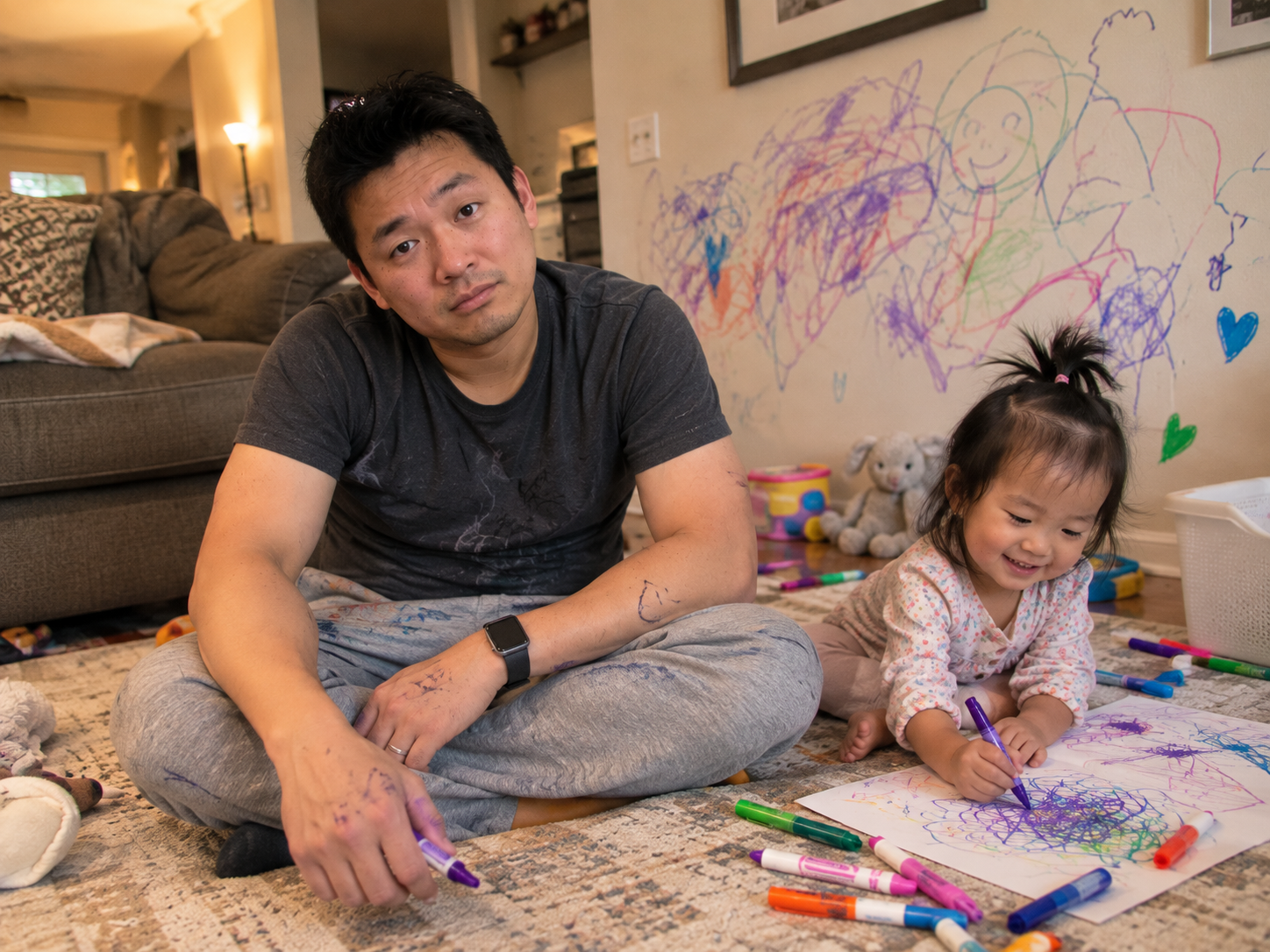
The Yelling Incident: The Day I Became My Father
It was a Tuesday, which is probably the most forgettable detail, except I remember it because nothing special happened. No big fight. No real emergency. Just another ignored plea to stop running around so I can get her jammies on. It was the third time I’d asked her to get ready for bed. I’d said it calmly twice. The third time, the words came out too fast.
| HOW MANY TIMES DO I HAVE TO TELL YOU?! |
The running stopped. And my daughter just looked at me — not crying, not even flinching, just wide-eyed in a way that landed like a fist tomy chest.
Here’s the part I can’t stop replaying: it wasn’t just that I yelled. It was whose voice came out of my mouth. The words, the pitch, the familiarity — I had heard it a thousand times growing up from my dad. In that half-second of silence after, I realized that a day that I never thought would come is staring me in the face. I’ve turned into my father.
This isn’t a story about one bad moment. It’s about the pattern behind it — and the long, unglamorous work of learning how to stop yelling at my kids and break it.

The Pileup: Why Yelling Almost Never Comes From the Child
Let me be precise about what actually happened that Tuesday, because the specific event that took place was not the problem.
The running around was just the last grain of sand. The pile had been building all day: a frustrating meeting at work, three hours of sleep debt from a restless toddler the night before, the dishes I’d said I’d do and didn’t, the 20 interruptions while my wife and I were trying to decide what’s for dinner. None of it had anything to do with a three-year-old who forgot what bedtime meant. For me, it was just an overload and my daughter was just the closest target.
That’s the lie yelling tells you in the moment: that it feels like discipline. It feels decisive. It feels like authority. It’s not. It’s emotions overflowing camouflaged as discipline. The child freezes, and you mistake the freeze for compliance, for respect, for something working. It accomplished neither. Just as it would be foolish to think a deer in headlights would learn to use a traffic light, it’s just as foolish to think scaring a child would help them obey something they don’t comprehend.
I’m not proud of any of this. I’m just telling the truth about it.
Here’s a small thing that helps me now: before I decide I’m angry at my kid, I run a HALT check. Hungry? Angry? Lonely? Tired? Nine times out of ten, the real fuel is one of those four, and my child is just the spark. Naming it doesn’t excuse the yell. It just lets me aim the diagnosis at the right place.
The Mirror Moment: I Heard My Father in My Own Voice
I grew up in a house where volume was the primary parenting tool. My dad wasn’t a monster — that’s the complicated part. He was a man who loved us and had absolutely no idea what to do with his own feelings, so they came out as orders, snapped jaws, slammed doors. Fear was the climate. You didn’t get explanations; you got consequences. You didn’t get heard; you got handled.
I spent my twenties quietly swearing I’d be different. My thirties doing the deep work of believing it. And then one Tuesday, one sentence, and there he was — in my throat, in my shoulders, an exact replica of his anger — pouring out of me like he’d been waiting in my body for years.
Therapists will tell you that noticing the pattern is the first step to breaking it. They’ll say it in a calm office voice. What they don’t tell you is that noticing stings. It’s a grief, honestly. Grief that the reflexes you inherited feel so automatic, grief that the thing you swore you’d never do slipped through anyway.
But here’s the reframe I’ve had to learn, slowly: the fear of repeating the cycle — that constant, heavy presence sitting on your chest at 2 a.m. — isn’t a sign that you’re failing, quite the opposite. That fear is self-awareness. My father didn’t have it. The fact that my yell scared me as much as it scared my daughter is the difference. I’m not my father. But I carry him in my reflexes. And that’s the part I have to reckon with, not once, but as an ongoing practice.
At this point, I should also step out of my 7 year old review of my dad, into a 30-something reviewing his actions in new lights. He was a great dad. I’m sure he did plenty of self-reflection and regretting, but he just never shared it with me, for a good reason…I was 7..what was I supposed to do with that information. Let’s be honest, all of us, our parents yelled a lot, not because it was fun, but mostly because we (all kids in general) can be that difficult. It might not be the best response, but I’m quite certain we deserved it. I realize that now more than ever with 2 kids of my own.
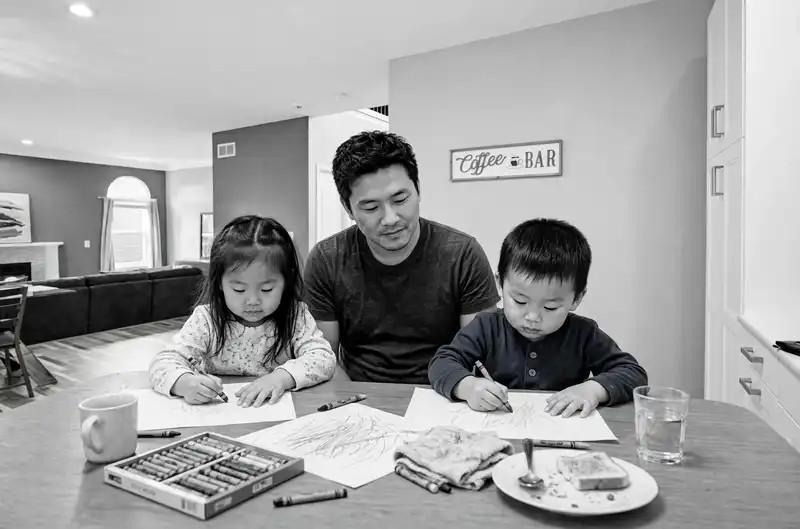
The Science and the Stakes: Why Repair Matters More Than Perfection
Let’s talk honestly about why yelling feels so effective. In the short term, it works: the child freezes. The room goes quiet. The mess gets cleaned up. But what the child learned in that moment wasn’t respect — it was fear. They learned that when a big feeling shows up, an even bigger one answers it. They learned that Dad’s love has a volume knob, and it can spike without warning.
Repeated yelling is linked to heightened anxiety and stress responses in kids. What they internalize isn’t the lesson about milk or bedtime — it’s the emotional weather. The lesson is: the people who love you can become unsafe without notice. Sit with that for a second. That’s the actual curriculum.
But here’s the part that saved me, and it’s the part I wish someone had told me before the guilt spiral set in: it’s not the rupture that defines the relationship. It’s the pattern of repair. Psychologists who work with families say the same thing: what matters most after losing your temper is what you do next.
Children don’t need perfect parents. Perfect isn’t even on the menu — it’s a fantasy that keeps dads either performing or despairing, and neither helps. What kids need is parents who return after mistakes. Parents who come back into the room, get low, and make it right. A relationship isn’t built in the absence of rupture. It’s built in what you do after.
How to Stop Yelling at Your Kids: Pause, Repair, Repeat
Knowing all of this is worthless without something to do with it at 8:47 p.m. when the mess is spreading. So here’s what’s actually worked for me — not every time, but increasingly.
The pause. When I feel the heat rising, I give myself a 10-second silent pause before I say anything. No words. Just breath. Sometimes I put my hand on my chest — a physical circuit-breaker that interrupts the old wiring. And here’s the counterintuitive one: I lower my voice instead of raising it. The body follows the volume down. It’s almost impossible to stay in a rage when you’re speaking quietly.
The repair (three steps). When I blow it — and I still blow it — I follow the same three steps, every time:
- Regulate yourself first. You cannot repair from the same nervous system state that caused the rupture. Walk to another room if you need to. Breathe until your jaw unclenches.
- Take responsibility without a “but.” “I’m sorry I yelled. That wasn’t how I wanted to handle it. You didn’t deserve that.” Full stop. Never “I’m sorry, but you made me angry.” The second you add the but, the apology becomes an accusation.
- Restore connection with warmth. Get down to their level. Eye contact. A hug if they want one. Remind their nervous system that you’re safe again.
Child psychologists teach a similar shape — Dr. Becky Kennedy’s four-step repair framework runs on the same core: own it, don’t qualify it, reconnect.
Reparenting while parenting. This is the deeper layer: after a slip, talk to your own wound with empathy instead of shame. Shame says “you’re your father.” Empathy says “you’re learning.” You cannot shame yourself into being a gentler parent. Show your own inner child the patience you’re learning to show your kid.
Backsliding. I’ll say it plainly: I still slip. Strong dads aren’t the ones who never fail — they’re the ones who go back, apologize, model accountability, and actually change the behavior after. Every repair is a lesson in accountability your child gets to witness up close. That’s not a consolation prize. That’s the work.
FAQ: What to Do After Yelling at Your Kids
What should I do right after yelling at my child?
Regulate yourself first — you can’t repair from the same state that caused the rupture. Then apologize without a “but,” and restore connection: get down to their level, make eye contact, offer a hug.
How can I stop yelling at my kids?
Catch the buildup before it peaks. I use a 10-second silent pause and deliberately lower my voice — the body follows the volume down. A HALT check (hungry, angry, lonely, tired) helps me aim the diagnosis at the real fuel, not my child.
Does yelling cause long-term damage?
Repeated yelling is linked to heightened anxiety and stress responses in kids — they learn the people who love them can become unsafe without notice. But both research and clinical experience point the same way: it’s the pattern of repair, not the absence of rupture, that defines the relationship.
How do I break the cycle of yelling I learned from my own parents?
Noticing is the first break. The fear of repeating the cycle isn’t failure — it’s self-awareness your parents may not have had. Then practice: pause, repair, repeat, and show yourself the same empathy you’re learning to show your kids.
Honest Closing: The Promise I Can Actually Keep
I could end this by promising I’ll never yell again. But that would be another lie, and this is about telling the truth and setting REALISTIC expectations.
The promise I can actually keep is smaller and harder: I’ll keep noticing. I’ll keep pausing. I’ll keep repairing. Progress in my house doesn’t look like perfection — it looks like fewer blowups, faster apologies, and a home where calm, not volume, carries the authority. It looks like my daughter, slowly, learning that mistakes — his and mine — get met with honesty and return.
So to the dad reading this who also heard his father’s voice coming out of his mouth tonight: you’re not alone. And the fact that it scared you — the fact that you’re sitting with it instead of shrugging it off — means you’re already doing the work. That’s not failure. That’s the beginning of the break in the cycle. Keep going.